
 Spanish
 English
 Italian
 Portuguese
 French
Welcome to Our Blog - ITG Group
Blog
- Textile industry
- Nov 10, 2026
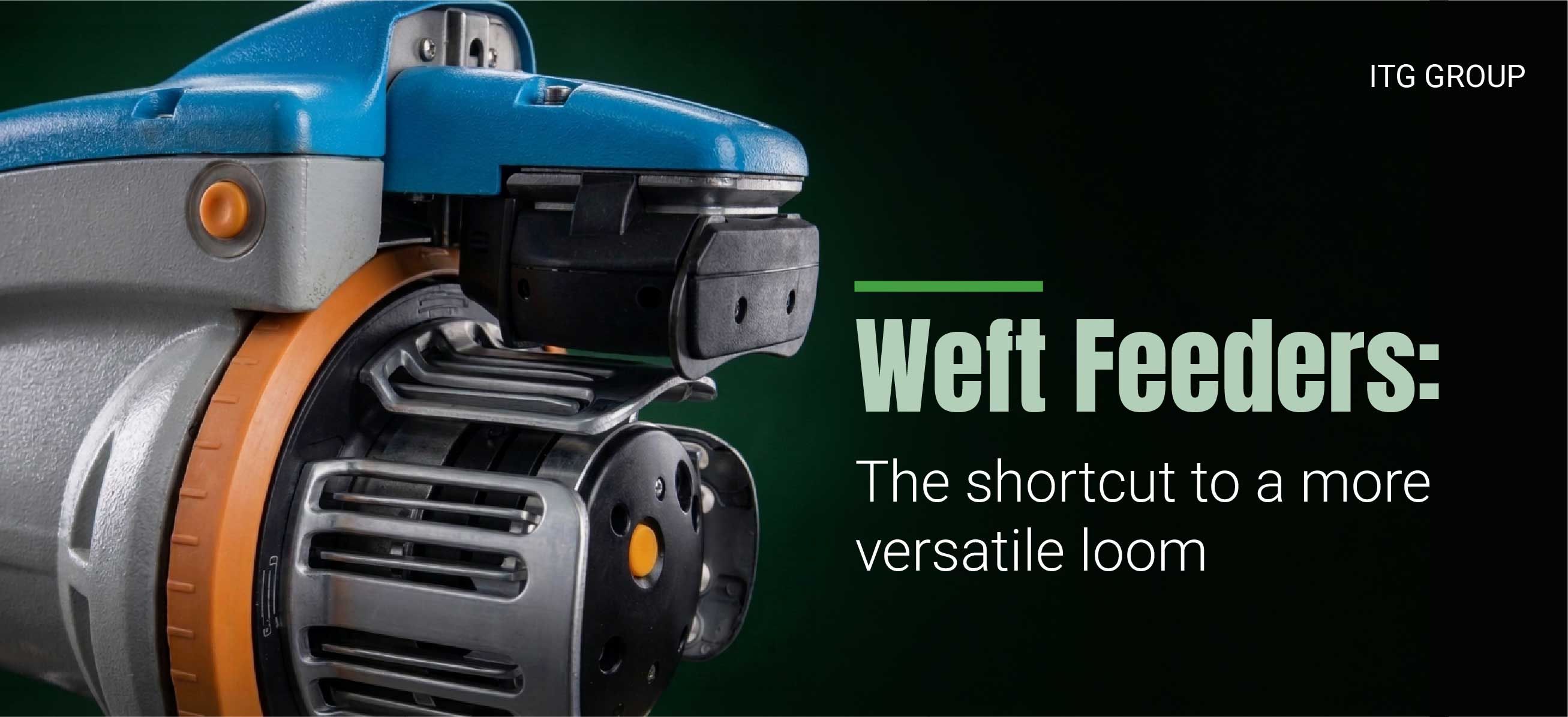
Weft Feeders: The Component That Decides How Many Fabrics Your Loom Can Weave
A loom is only as versatile as what feeds it. When a mill wants to weave something new, the first conversation is usually about looms. A new article, a new market, a design with more colours: it sounds like a machinery decision. But in many cases the limit isn't the loom. It's the weft feeder in front of it, which decides which yarns the loom can run, how many colours it can insert and how fast it can switch from one article to the next.
This article looks at the weft feeder from that angle: not as a part that keeps the loom running, but as the part that decides how much the loom can do.
Versatility in yarn: one feeder, many articles
The first thing a feeder sets is the range of yarns a loom can take. The wider that range, the more articles one loom can carry without changing equipment.
Our weft feeder and measurer for jet looms runs yarns from 20 denier to 3.5 Ne, at weft feeding speeds up to 1800 m/min.
The SHG-135A covers 22 to 5000 dtex, with yarn separation adjustable up to 4 mm.
The TS-612G2 and TS-613G2 series are built for uniform weft tension across a wide range of counts, on all kinds of rapier and projectile looms.
What makes that range usable day to day is how quickly the feeder adapts when the article changes. Winding direction is set to S or Z according to the yarn's twist. The separation between coils on the drum is adjustable. On the TS series, the S/Z interval is continuously adjustable. Changing article means changing settings, not changing the feeder.
Versatility in colour: from one weft to several
This is where a feeder changes what a loom can sell.
A loom that inserts a single colour is limited to the fabrics a single colour allows. Our insert systems take that limit away on the loom you already have:
WIS-2WH upgrades a single-colour water-jet loom to a 2-colour pick-at-will loom.
WIS-3WH takes a single-colour water-jet loom to 3 colours pick-at-will.
FDP with our control system upgrades a single air-jet loom to 2 colours pick-at-will.
SH-RL is a roller insert system for 2 colours pick-at-will on water-jet looms, for yarns from 20 to 600 denier.
SWIS-6/8A runs 6 or 8 feeders on air-jet looms, with colour selection controlled by the loom.
On the water-jet systems, the pattern can be controlled by the dobby, which addresses pattern synchronisation at the root. The result, in the catalogue's own words: the weaving range of the loom is enlarged, and higher-value products can be woven.
For a mill, that's the difference between buying new looms to enter a new type of fabric and adding that capability to the looms already on the floor.
Versatility across the floor: one range for every insertion technology
Most mills don't run a single loom technology. A floor might have rapier looms on one line, air-jet on another and water-jet on a third, each with its own feeder requirements. Our range covers all of them:
Rapier and projectile: TS-612G2 and TS-613G2, up to 1500 m/min, with automatic speed control and a weft-break stop function. The SH2000C3 is developed specifically for speed rapier looms.
Jet looms: our weft feeder and measurer, with photocell coil detection and weft-break detection that triggers either a loom stop or automatic weft changing.
Air-jet: the FDP, which can substitute Tsudakoma FDP feeders on looms up to 800 rpm, and the SWIS-6/8A system.
Water-jet: the WIS series, the SH-RL and the LHL-1W.
The feeders adapt to the electrical side, too. The FAC-1 works with a control box at AC 3-phase 90 V, the SH2000C3 with AC 3-phase 45 V, and the TS-612G2 electric boxes cover standard voltage ranges, with customised boxes for the voltages outside them.
For the person who buys and maintains them, one supplier for every technology on the floor means one conversation, one catalogue and one source for parts.
Versatility that pays for itself
Expanding what a loom can weave usually comes with a cost question. On the water-jet insert systems, part of that cost comes back in operation:
No blast motor. The WIS systems no longer need the blast motor for measuring length on a mechanical feeder, which saves electrical power and reduces maintenance costs, since the feeder is easier to replace.
Less weft waste. Weft length is adjusted through the diameter of the storage drum and the number of release turns, so weft waste can be avoided.
And where a full multi-colour upgrade isn't the goal, the LHL-1W combines mechanical measurement with electronic control, needs no blower, and suits looms up to 800 rpm and widths from 1.25 to 2.8 m.
Keeping versatility under control
A feeder that can do more also has more settings to get right. Every time you change article, colour configuration or yarn, check these:
Count range. Your finest and your heaviest yarn both have to fall inside the model's range.
S or Z. Winding direction follows the yarn's twist. A new yarn can mean a new setting.
Separation. Set the gap between coils for the yarn you're running now, not the setting left over from the last article.
Break response. Confirm whether the setup is configured for a loom stop or automatic weft changing.
Parts on hand. We supply wool rings, front and rear tensioners, elastic drums, sensors, compensators, main boards and electric boxes. When a feeder stops, the fastest fix is usually a part, not a new unit.
Before you buy another loom
If the plan is to weave more yarns, more colours or more articles, it's worth asking first what the looms you already have could do with a different feeder or insert system. Sometimes the answer is a new loom. Often it isn't.
Tell us your looms, your yarns and the fabrics you'd like to weave next, and our team will help you work out what the feeder can open up: info@group-itg.com
- Technical
- Oct 27, 2026
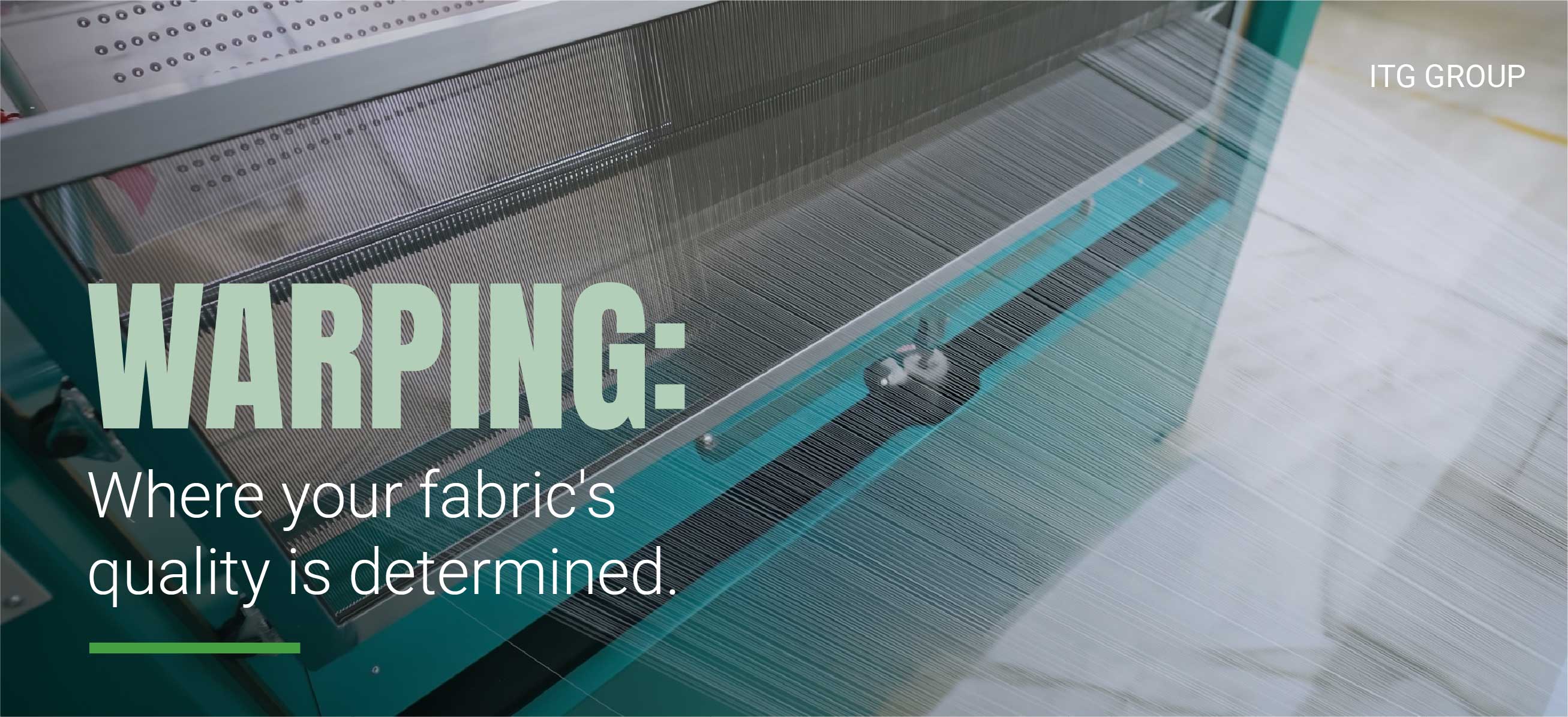
Warping: Where Your Fabric Quality Is Determined
Here's an uncomfortable possibility: by the time yarn reaches the loom, a defect may already be wound into the beam.
Warp preparation is the quietest stage of the whole process. Nothing dramatic happens there. But it's where the conditions for fabric quality are set — and a badly warped beam carries its problems forward into every metre woven from it.
What a beam actually carries
A warp beam isn't just yarn on a flange. It's thousands of ends wound under a specific tension, at a specific density, in a specific arrangement. Get those three things right and the loom receives a warp it can work with. Get any of them wrong and the loom spends the whole run compensating.
We wrote in August about a study of loom stoppages in an air-jet weaving mill, which found that 58% of all stops were caused by warp breakages — by far the largest category, ahead of weft breaks and everything else combined. That article looked at the components the yarn passes through on the loom.
But there's a stage before that. A warp end that was wound under uneven tension, or that sat in a low-density zone of the beam, arrives at the loom already weakened or already slack. It doesn't break because the loom mistreated it. It breaks because it was never going to survive the run.
The three variables set at warping
1. Tension uniformity across the sheet. Every end on the beam should be wound under comparable tension. When some ends are tighter than others, the loose ones sag in the shed and the tight ones take more stress on every pick. The result at the loom looks like random warp breaks and shed irregularity — but the pattern was set when the beam was wound. This is why warping machines carry dedicated tension architecture: constant-tension mid-devices exist specifically to keep tension the same between different yarns and different strips, with the tension of each yarn sheet freely adjustable.
2. Winding density consistency. A beam wound at inconsistent density unwinds at inconsistent tension — because the effective diameter changes unevenly as the beam runs down. The catalog is direct about this: on the intelligent warping station, closed-loop tension control with tension units and automatic displacement measurement exist to "guarantee better winding of warp beam and keep constant winding density." On direct warping, winding density error is specified at ≤0.25%. And on detach warping, real-time tension compensation is what delivers density consistency not just within a beam, but between all the beams in a set — which matters the moment you're running a loom fed by more than one.
3. Stripe and band alignment. On sectional warping, where the warp is built in strips on a drum, alignment is everything. If the stripes drift, the resulting beam has zones of different density and the fabric shows it as banding. The engineering answer is geometric: on the SHGA215C, the warping section moves along a rail while the leasing reed and creel stay fixed, so the warp stripe stays aligned and centred throughout the process — and stripe tension stays constant with it. Precision figures on sectional warping run to ≤0.1 mm for strip location and 0.02% for conducting bar follow-up.
Why it stays invisible until the loom
Here's the structural problem: warping defects don't look like defects. A beam with uneven tension looks like a beam. A beam with 3% density variation looks identical to one with 0.25%. There's no visual inspection that catches it, and the warping department has usually moved on to the next beam by the time the first one reaches the loom.
So the feedback loop breaks. The weaving department logs warp breaks. The warping department hears nothing. And the same condition gets reproduced on every beam, because nobody connected the two ends of the problem.
Length accuracy behaves the same way. On our High Speed Direct Warping Machine GA269C, multiple sensors with automatic deviation correction hold length deviation under 0.0025% — a figure that only matters because the alternative is discovering the discrepancy at the end of a run, when you're short of fabric or long on waste and the beam is already gone.
Where the yarn is actually damaged
It's worth being precise about this, because "warping damages yarn" is too vague to act on. The damage happens at specific points, and each one has an engineering response.
At the creel, yarn is under tension and in motion, and friction-sensitive staple fibres are the most vulnerable. V-shaped recirculated creels are built for exactly this — they let yarn work under low tension at high speed, which reduces tension differences and end breakage during warping. Anti-air-balloon devices and pre-tension rods soften the tension compensation when the motor starts and stops, so the yarn isn't shocked at every acceleration.
At the pressure roller, the yarn is being compacted onto the beam. On the GA269C, pressure is adjustable from 150N to 6000N through an independent pneumatic mechanism, with automatic return during braking so the roller stops rubbing the yarn already on the beam. That automatic return exists because the alternative — a loaded roller sitting against a decelerating beam — abrades the outer layer.
And at the reed, dust and fly accumulate. Intermittent blow mechanisms and closed reed devices exist to keep that contact point clean, because a reed tooth carrying lint is a reed tooth abrading yarn.
A verification framework
If you're getting warp breaks or banding you can't trace, work through this before you keep adjusting the loom.
Check whether breaks cluster by beam, not by loom. If the same loom runs clean on one beam and breaks on the next, the variable isn't the loom.
Check whether breaks cluster by zone of the beam. Problems that appear consistently at a certain point in the run — early, middle, near the end — point to density variation across the beam diameter.
Compare beams within a set. If you're feeding a loom from multiple beams and one behaves differently, you have a between-beam density consistency problem, not a weaving problem.
Look at your banding against your stripe geometry. On sectional warping, banding that repeats at regular intervals across the fabric width is an alignment question, not a reed question.
Ask what tension your warping machine actually holds — and whether anyone measures it. If the answer is "it's set on the panel," that's a setting, not a measurement. Closed-loop tension control means the machine corrects; open-loop means it hopes.
Close the feedback loop. Give the warping department the warp-break data from weaving, by beam. It's the single cheapest diagnostic change available, and most mills have never done it.
The cost argument
For anyone weighing this as an investment rather than a maintenance question: warp preparation is upstream of everything. A defect introduced at the loom affects the fabric being woven. A defect introduced at warping affects every metre of every beam produced under those conditions — and it does so invisibly, which is what makes it expensive.
That's the asymmetry worth understanding. Warping equipment doesn't produce fabric, so it rarely gets prioritised in a capex conversation. But it sets the ceiling on what the rest of your line can achieve. You cannot weave better than your beam allows.
Where ITG Group fits
Our warping range covers direct and sectional warping, — with creel and tension configurations selected according to the yarn you actually run, not a default specification.
If you're seeing warp breaks or banding that don't resolve at the loom, that's a conversation worth having before your next equipment decision. Tell us what you're running and what you're seeing, and our technical team will work through it with you — including the case where the honest answer is that your warping is fine and the problem is somewhere else.
Get in touch: info@group-itg.com

- Innovation
- Oct 19, 2026
Buying Second-Hand Machinery Shouldn't Be a Gamble: Introducing ITG Machinery
Buying second-hand machinery should be a smart way to grow. For many mills, it feels more like a bet.
The logic behind it is sound: a second-hand loom or warping machine can bring capacity online faster, with a smaller investment than new equipment. What holds most buyers back isn't the price. It's the question a typical listing never answers: what condition will this machine actually be in when it reaches my factory?
The real problem with the second-hand market
The second-hand machinery market isn't short on offers. It's short on accountability.
A listing tells you the brand, the model, maybe the year. It rarely tells you how the machine was running before it came off the line, whether anyone has checked it since, or who you call if it doesn't perform once it's installed. In many deals, the seller's involvement ends at the transaction, and every risk after that is yours: parts nobody warned you about, a start-up that takes longer than planned, capacity you budgeted for that never shows up.
For a factory owner, that's capital tied up in uncertainty. For a purchasing manager, it's a supplier decision that's hard to defend if it goes wrong. In both cases, the machine itself is rarely the whole problem. The missing backing is.
What changes with ITG Machinery
ITG Machinery is ITG Group's department dedicated to second-hand machinery. It manages the selection and commercialisation of second-hand equipment from start to finish, and the word that matters most there is selection.
Every piece of equipment is evaluated against specific criteria of quality, operation and reliability. Our technical and commercial team assesses each option before it's offered, and each machine is thoroughly inspected so it arrives ready for your production line.
That changes the question you're asking. Instead of “what am I actually getting?”, it becomes “which of these fits my production?”, and you answer it with people who have already looked at the machine.
The platform covers machinery from leading brands such as Picanol, Toyota, Vamatex, Itema, Dornier, Sulzer and many others. Behind it is the same group you may already know from spare parts and new machinery: decades in the textile industry and a distribution network in more than 50 countries.
That's what we mean by second-hand machinery, first-class backing.
The people behind the backing
Backing isn't a policy. It's the people who answer when you have a question.
ITG Machinery is led by Fabio Giamminola, General Director of ITG Brasil, who brings the group's commercial and technical experience to every selection. Alongside him, Vania and Arissa run the administrative and commercial side of the process. They're the team you'll be speaking with from your first inquiry until the offer reaches you.
This matters more than it might seem. When you buy secon-hand equipment, you're not only buying a machine. You're trusting someone's judgement about it, and knowing who that someone is, and being able to reach them, is part of the backing.
How to get started
Everything happens directly on the platform, in three ways:
Buy from the listing. Start by browsing the machines currently available. If you find the reference you're interested in, send your interest request through the platform, and the negotiation starts from there.
Request a search. If the machine you need isn't on the listing, you don't have to stop there. Submit a search request: register your company and describe the machinery you're looking for. The ITG Machinery team will then help you find it.
Sell your machinery. Machinery your mill no longer uses can still be valuable to another one. Register it through the sales form, upload its details and photos, and submit it for publication on the platform, where it can reach thousands of potential buyers in the textile industry worldwide.
Buying second-hand shouldn't mean buying blind
Take a look at the current offer on the ITG Machinery platform, or write to us at itg.machinery@group-itg.com. Tell us what your line needs, and we'll tell you whether we have the right machine for it.
- Textile industry
- Oct 14, 2026
Nextech 2026: Discovering Where the Textile Industry Is Headed
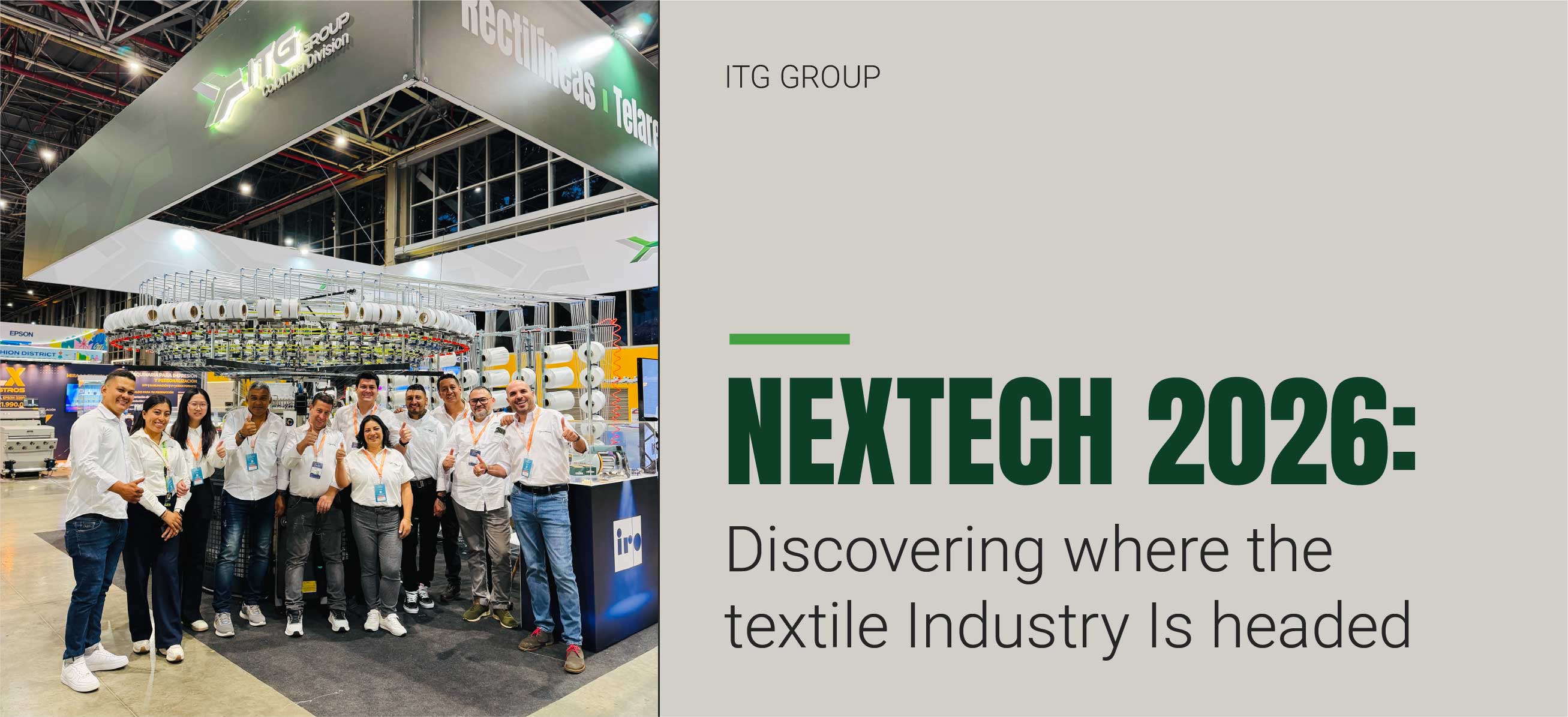
From September 22 to 24, we attended the first edition of Nextech by Colombiatex at Plaza Mayor in Medellín. It is Latin America’s first trade show specializing in machinery and technology for the textile and apparel supply chain. According to Inexmoda, Colombia accounted for 6.8% of the Latin American fashion market in 2025—approximately USD 8,494 million—and the industry is asking itself how to produce better, not just more.
At our booth, we had knitting looms, braiding machines and SINOTEX flat knitting looms in operation. We had visitors from different cities in Colombia, as well as from Ecuador, Peru, Argentina, and Europe, and a good portion of them were companies we hadn’t worked with yet. Almost all conversations revolved around four topics.
Topic 1: Knitting remains the foundation, but growth doesn’t always mean buying another machine
This was the most frequently asked question. Before adding a machine, check if you can diversify with the one you already have:
Change parts, not the machine. On single-knit knitting machines, by changing the core components, the same machine can be converted to knit terry or polo fabric.
Change the gauge with a new cylinder. You can produce a different type of fabric with the same equipment and a much smaller investment than that of a complete machine.
Choose wisely between tubular and open-width knitting. If you work with fabrics containing Lycra or light colors and the fold of the tube leaves marks, the open-width method rolls up the spread-out fabric, preventing those wrinkles and maintaining a uniform stitch density. If you produce garments without side seams, the tubular method remains the most efficient option.
Topic 2: For collars and cuffs, the difference lies in the design
Every technique you master is one more product you can offer: mini jacquard, embossed pleats, intarsia, transfers, or shaped collars. If you’re evaluating a flat knitting machine, keep this in mind:
Rising and lowering rollers: the fabric comes out straight without needing to be hung by hand.
High-heel needles: the cams wear less.
Servo-controlled motor: according to the manufacturer, it increases production by 15%.
Four lancing bars and eight feeders: more colors in a single design.
Topic 3: In braiding, continuity comes down to the details
Braiding is used in shoelaces, sports and safety ropes, fishing line, headphone cables, and jacquard cords, made of polyester, nylon, PP, or Dyneema. If you’re considering a braiding machine:
It’s part of the final product. The number of spindles and heads determines what you can produce and at what rate.
Look for an automatic shut-off in case of thread breakage to avoid accumulating defective lengths. According to the manufacturer, some rope-making models produce 4 to 5 times more than a traditional braiding machine.
Keep consumables close at hand. With spools, carriers, springs, and brake pins readily available, a stoppage lasts hours rather than weeks.
Think about the finishing. If you produce cords, an automatic stitching machine capable of 4,000 to 6,000 stitches per hour completes the process without relying on manual labor.
Topic 4: The cutting room has become a major topic of conversation
Automatic fabric spreading and cutting machines—a line we recently introduced with YINENG TECH—were among the most frequently inquired about. Fabric typically accounts for 60% to 70% of a garment’s cost, and Lectra estimates that waste in cutting rooms ranges from 10% to 20%. It is one of the largest cost centers in a garment manufacturing operation and almost always the least measured.
Before looking at any technical specifications, measure these four things over the course of a typical month: your marking efficiency by garment type, your scraps and rework by cause, the actual hours your cutting table is in use, and your true bottleneck (consistency, setup time, or volume). Also, evaluate spreading and cutting together. An automatic cutting machine only cuts the fabric layout it is fed. If the fabric is still laid out by hand, you’ve automated the precise step and left the imprecise one as it was.
Before Making a Decision
Anyone returning from a trade show comes back with options on the table. These four questions help you sort through them:
What are you going to produce, and for which market?
What is the actual productivity with your yarn and your shifts?
Are replacement parts available nearby?
What does the support for installation, commissioning, and training include?
Most decisions to invest in machinery are made months after a trade show, when there’s time to compare options calmly. We’ve seen this happen in other divisions of the group, which is why we never consider any conversation closed. If you submitted a request, our sales team will reach out to you to help bring it to life. And if you didn’t get a chance to visit us or want to discuss any of these topics for your plant, please write to us.
Thank you to everyone who stopped by to visit us during Nextech.