 Spanish
 English
 Italian
 Portuguese
 French
Welcome to Our Blog - Your stenter is burning margin — and you can hear it in the exhaust fan
Your stenter is burning margin — and you can hear it in the exhaust fan
- Technical
- Sep 08, 2026
Your stenter is burning margin — and you can hear it in the exhaust fan
If you run a finishing line, you already know which machine you'd check first if the energy bill jumped: the stenter.
It's usually the single largest thermal energy consumer on the floor, and the reason is simple physics — you're pushing wet fabric through chambers of hot circulating air, and generating that heat, chamber after chamber, shift after shift, is expensive. The literature is blunt about it: the stenter is described as one of the most thermal-energy-consuming machines in the entire textile process, and finishing together with wet-processing preparation accounts for roughly 35% of a composite mill's thermal energy.
Here's the part that doesn't show up on a gauge: a large share of that energy never touches your fabric. It leaves through the exhaust stack as hot air, radiates into the workshop, or gets wasted holding temperature the process didn't need. That's not a dramatic failure. It's a quiet, continuous leak — and it's paid for in every meter of fabric you run.
This article breaks down where a conventional stenter loses energy, and how the design of our XY-D-2600 Stenter Machine attacks each loss at the source.
Where a conventional stenter loses energy
Three losses account for most of the waste, and they compound.
Hot exhaust air, thrown away. A stenter continuously vents humid, hot air to keep the chamber atmosphere right for drying. In a conventional setup, that exhaust — carrying real thermal energy you already paid to generate — goes straight up the stack. Research on stenter energy flows identifies exhaust gas as one of the single biggest bottlenecks to efficiency, and studies on waste-heat recovery from stenters have demonstrated fuel-consumption reductions above 60% when that exhaust heat is properly captured and reused. Every degree in that vented air is money spent once and lost.
Thermal leakage and radiation. Heat doesn't stay politely inside the chambers. It escapes through panel walls, gaps and poorly insulated surfaces — which is why the area around an older stenter is often uncomfortably hot. That radiated heat is doubly costly: it's energy that left the process, and it raises the workshop temperature, which your ventilation then has to fight.
Temperature and airflow you can't control precisely. When you can't independently regulate conditions across the machine — top versus bottom, section by section — you compensate by overshooting. You run hotter or push more air than the fabric strictly needs, just to hold quality. That safety margin is real fabric quality insurance, but it's also continuous over-consumption. And atmospheric conditions make it worse: energy-model studies show stenter performance can swing by up to 10% of total energy required just from seasonal changes in ambient air temperature and humidity.
How the XY-D-2600 attacks each loss
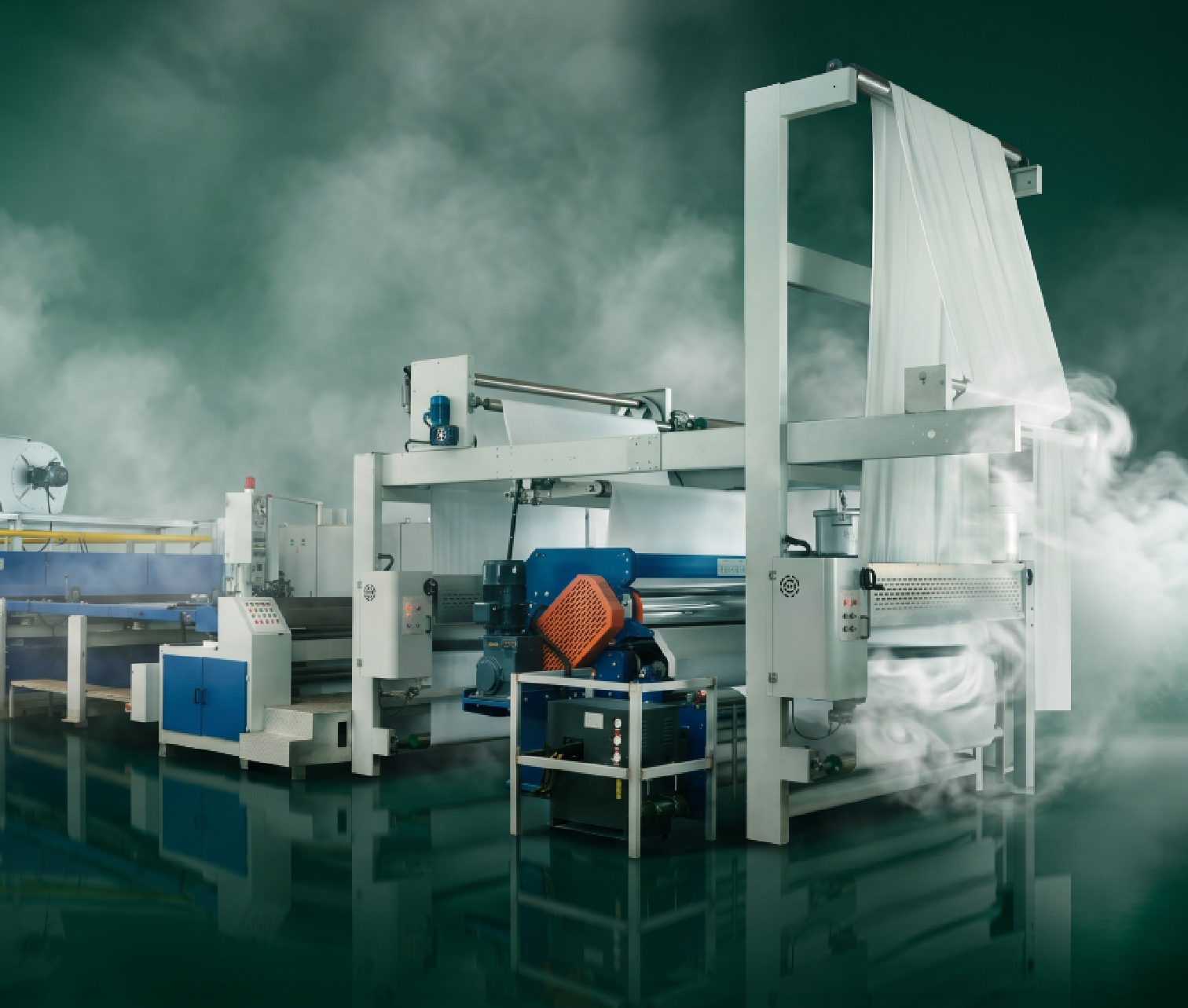
The XY-D-2600 Stenter Machine is a double-layer stenter built specifically around energy consumption. Three design features map directly onto the three losses above.
1. Double-layer oven — reusing heat instead of regenerating it. This is the core idea. The oven is stacked in two layers, and the heat generated in the first heat-setting layer is transferred to the second layer through a closed iron plate. Instead of every chamber generating its own heat from zero, the second layer runs partly on heat the first layer already produced. Per the catalog, that recovery is worth about 20%–40% energy saving, depending on the process. And because the layers are stacked, each cabinet is 1600 mm high — you get that saving without doubling your floor area.
2. Waste-heat recovery — preheating fresh air with air you were going to vent. The second attack is on that exhaust stack. A stenter constantly needs to replenish fresh air into the oven. In the XY-D-2600, that incoming fresh air is routed through the waste-heat recovery device first — so it's preheated by the outgoing exhaust before it enters the chamber. You're recovering energy from the exact air you were about to throw away. The catalog puts this at roughly 10%–30% energy saving. The exhaust and supplementary fans are both frequency-controlled, and the system reports a 2%–3% production-efficiency gain on the same line, depending on process conditions. The insulation backs it up: panels are galvanized plate with 150 mm of high-quality insulation material to shut down the heat leakage described earlier.
3. Independent dual air ducts — precision instead of overshoot. The third feature solves the over-consumption problem. The XY-D-2600 uses two independent air ducts, with upper and lower air volume controlled separately and settable to any ratio through the menu, regulated by frequency converters. That means you stop compensating with blanket overshoot and start matching airflow to what the fabric actually needs, top and bottom. Critically, this holds even at low speed — which is exactly where sensitive fabrics live. The catalog specifies stable fabric results at any speed for knitwear, coated fabric, recycled fabric, ultra-fine fiber, plush and silk. Lower, precise airflow on delicate goods is both an energy saving and a quality safeguard at once.
What this means on the bill — and in the fabric
The savings percentages above aren't marketing rounding — they're catalog figures tied to process conditions, and they stack on the machine that's already your biggest energy line. When your single largest thermal consumer runs 20%–40% more efficiently in the oven and recovers another 10%–30% from exhaust, that isn't a rounding error on the energy bill. It's a structural change to your cost per meter — the kind that compounds every shift, every day, for the life of the machine.
Independent industry work points the same way: waste-heat recovery projects on stenters have reported 20%–30% savings in electricity and fuel, and broader stenter modernization is credited with cutting specific energy consumption by 10%–25%. We're not going to hand you an ROI figure — that depends on your energy price, your fabric mix and your run hours, and anyone who quotes you a universal payback is guessing. But the direction is not in question, and the inputs to calculate your own are all here.
And the quality side matters just as much, because energy efficiency that costs you fabric quality isn't efficiency. The same features that save energy — precise dual-duct airflow, heated fresh air fed in to avoid large temperature differentials and dripping, stable conditions at low speed — are the features that protect hand feel and finish consistency on sensitive fabrics. On a stenter, done right, the energy decision and the quality decision are the same decision.
Where ITG Group fits
ITG Group supplies the XY-D-2600 double-layer stenter, and our role doesn't end at the purchase order. Sizing a stenter to your line — chamber count, working width, heat source, the fabrics you actually run — is a technical conversation, not a catalog pick. If your current stenter is running hot, venting heat into the workshop, or forcing you to overshoot temperature to hold quality, those are the symptoms worth evaluating.
Tell us what you're finishing and the conditions you're running, and our technical team will work through the configuration with you — including an honest read on whether the numbers justify the change for your specific operation.
Get in touch: info@group-itg.com