 Spanish
 English
 Italian
 Portuguese
 French

Welcome to Our Blog - The Frame Problem: How Low-Quality Heald Frames Quietly Drain a Mill's Productivity
The Frame Problem: How Low-Quality Heald Frames Quietly Drain a Mill's Productivity
- Technical
- Aug 03, 2026
The Frame Problem: How Low-Quality Heald Frames Quietly Drain a Mill's Productivity
Ask any weaving manager what stops their looms, and you'll hear about yarn quality, humidity, machine age. What you'll rarely hear about is the component doing millions of movement cycles right in the middle of it all: the heald frame.
That's a blind spot — because the numbers say frames deserve far more attention than they get.
A study of loom stoppages in an air-jet weaving mill found that 58% of all stops were caused by warp breakages — by far the largest category, ahead of weft breaks (34%) and everything else combined (8%). And here's the detail that matters for this article: where the warp breaks determines how long the loom stays down. A break near the reed can be repaired with a quick knot. A break in the heald and drop wire zone takes significantly longer — the weaver has to identify the affected heald wire, rethread the yarn, and restart.
The same body of research puts the average warp break repair at around 2.87 minutes. That sounds small — until you multiply it across every loom, every shift, every day. A mill running dozens of looms with an elevated warp break rate is losing full production hours daily, one "small" stop at a time.
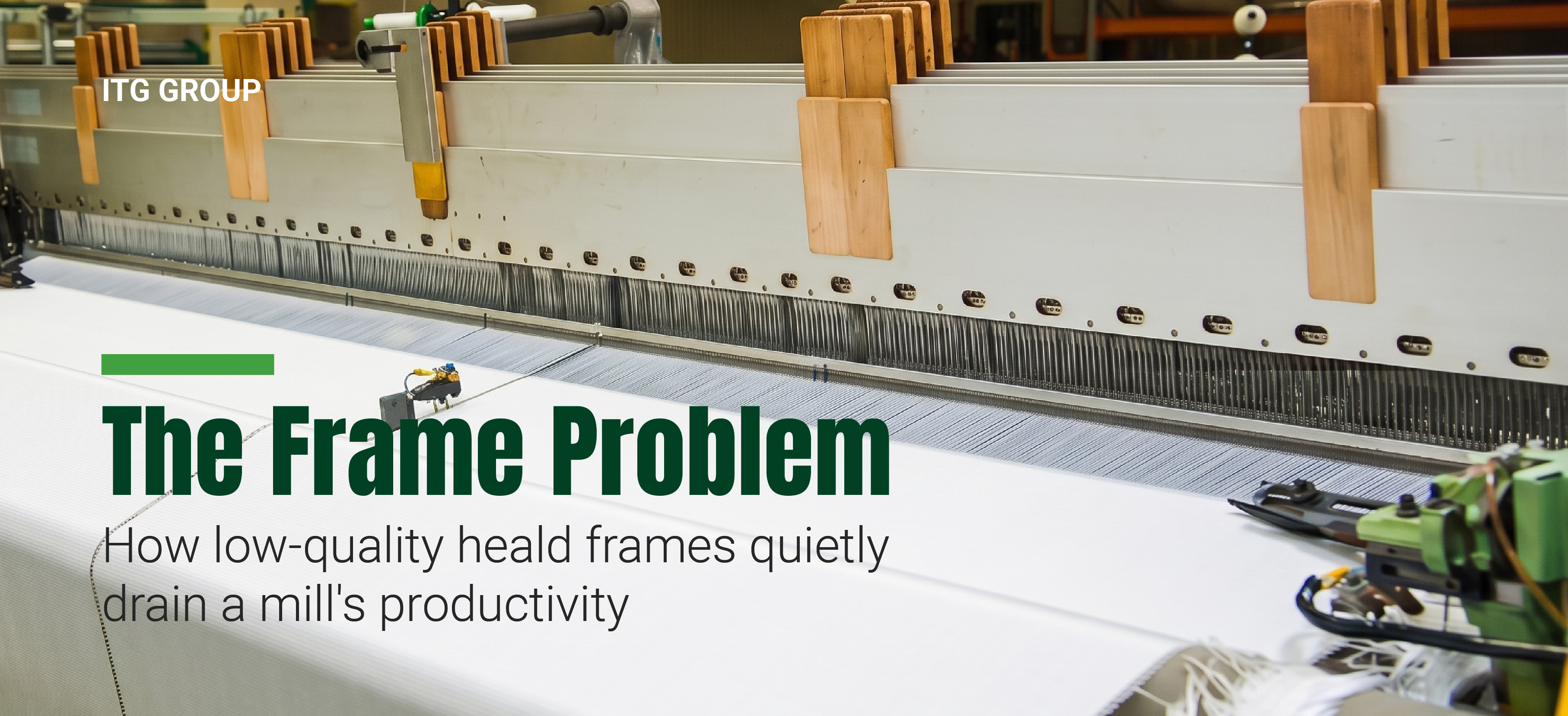
The heald frame endures millions of high-speed movement cycles, constantly interacting with heald wires and bearing tension from the warp. Research on heald frame design identifies it as one of the loom components most responsible for vibration and noise — and vibration is precisely what limits high-speed performance.
When a frame is poorly built or worn, the chain reaction looks like this:
1. Excess vibration transfers stress to the warp yarns on every shedding cycle
2. Stressed yarns break more often — feeding that 58% category of stops
3. Worn or misaligned frames force mills to reduce loom speed just to keep running
4. Frames that can't hold up wear out faster, doubling replacement frequency — and doubling the downtime each replacement requires
Industry analysis of weaving components is blunt about it: a poor-quality or worn heald frame doesn't just reduce weaving speed — it causes warp thread breakage, creates defects on the fabric surface, and increases maintenance costs simultaneously.
Every unplanned stop carries three costs at once: lost production, idle labor, and quality risk. That last one is the most underestimated — loom stoppages don't just pause output, they leave startup marks and differential dye take-up woven into the fabric as visible defects. The stop ends; the defect ships.
Industry benchmarks target under 10% total downtime for efficient weaving production. A mill whose frames are quietly inflating its warp break rate can blow through that threshold without a single "major" breakdown ever appearing in the maintenance log.
When a mill audits its downtime, the heald frame rarely gets a line item — the stops get attributed to "warp breaks" and the analysis ends there. But if warp breaks are your biggest stop category, the components touching those yarns thousands of times per minute deserve to be your first inspection point, not your last.
A frame is not a commodity. At production speed, it's the difference between a loom that runs and a loom that stops.
At ITG Group, our heald frames for high-speed air-jet looms are engineered for exactly this: durability, reduced maintenance costs, and stable performance up to 1000 RPM, compatible with Picanol, Toyota and Tsudakoma looms. If recurring stops are eating your production hours, our technical team can help you evaluate whether your frames are part of the problem.
Sources: Austin Journal of Textile Engineering (loom stoppage study); research on heald shaft design and vibration (composite heald frame studies); VieTextile component selection analysis; Textile School downtime benchmarks.